Hwee Ling Lim: Available Monday – Tuesday and Thursday – Friday
Chantelle du Boisee: Currently on secondment to MAPS until end of February 2026
For non-urgent clinical advice:
Phone: 0417 995 153 (8.00 AM – 4.30 PM) Please leave a voicemail or text message if there isn’t an answer.
Obstetric doctors:
Phone: 9382 6111 Ask the operator to page the on-call obstetric registrar for ANSC.
Obstetric medicine physician registrar:
Phone: 9382 6111
Monday – Friday (9.00 AM – 5.00 PM)
Ask operator to page the registrar.
Birth unit:
Phone: 0439 869 035 or 9382 6100 for 24/7 urgent advice from 20 weeks pregnancy.
Welcome Our New ANSC Obstetrician: Dr Sara Ooi
We are pleased to introduce Dr Sara Ooi, who has joined the antenatal shared care obstetric team.
Referral Pathways: RHW Antenatal Service
When referring patients for ANSC, women are typically allocated to:
Dr Louise Fay
Dr Stephen Coogan
Dr Sara Ooi
Midwifery group practice (MGP):
If a patient prefers MGP and capacity is available, please continue to refer to an ANSC obstetrician. Once the referral is received, RHW will allocate an appropriate MGP obstetrician internally.
Clinical business rules (CBRs): RHW guidance for GPs
It is the responsibility of all ANSC GPs to utilise and adhere to the Royal Hospital for Women (RHW) Clinical Business Rules (CBRs) to ensure safe patient care and evidence-based clinical decision-making.
The Australian Pregnancy Care Guidelines are a nationally endorsed set of evidence-based recommendations for pregnancy care in Australia. Australian Pregnancy Care Guidelines
Routine early pregnancy investigations
Standard tests: FBC, Blood Group & Antibody Screen, Rubella IgG, Hepatitis B surface antigen, Hepatitis C antibody, Syphilis serology (at booking and again at 26–28 weeks), HIV, MSU (midstream urine).
Consider if clinically indicated: Ferritin (high risk of iron deficiency), CST (if due), Chlamydia (if <30 years or based on risk), TSH+T4, HbEPG, Chlamydia PCR, Gonorrhoea PCR, HbA1c (women with risk factors < 13 weeks gestation), Early GTT for women with risk factors and a normal HbA1c.
Additional counselling: Dating ultrasound scan, 11- 14 weeks screening, combined first trimester screening (Maternal blood serum+ Nuchal translucency ultrasound) OR NIPT +structural ultrasound.
As part of the National Preterm Birth Prevention Collaborative, all pregnant women attending antenatal care within SESLHD have:
Cervical length measured at mid –term morphology ultrasound
Transvaginal ultrasound is required when:
A history of previous pre-term birth exists, or
Where it is not possible to obtain a satisfactory transabdominal view of cervical length, or
Cervical length is <35mm on transabdominal imaging
Haemoglobinopathy screening in pregnancy:
Perform haemoglobinopathy screening during the early routine antenatal blood tests (including FBC, haemoglobinopathy screen, and iron studies). Ensure ethnicity is documented on the request form. This screening should be done if not performed previously, if prior results are unavailable, or if the patient has any of the following risk factors:
High risk ethnicity: Central and Southeast Asian, Indian, Sri Lankan, Pakistani, Bangladeshi, Middle Eastern, Mediterranean, African descent, Pacific Islander or New Zealand Maori, Central/South American, Brazilian
Mean corpuscular volume (MCV)<80fL or mean corpuscular haemoglobin (MCH) <27pg
Known haemoglobinopathy carrier, family history of haemoglobinopathy in woman, biological father or gametes donor’s family
Universal thyroid screening in pregnancy is not recommended. Instead, targeted screening should be performed in pregnant woman with the following below listed risk factors:
History of past thyroid disease
Known thyroid antibody positivity
Age > 30 years
BMI >40
Personal or family history of autoimmune disease e.g. T1 diabetes mellitus, coeliac disease
Presence of goitre
Residing in an area of known iodine insufficiency
Use of medications that can affect thyroid function e.g. lithium, amiodarone
History of infertility, pregnancy loss or neck irradiation
For management of abnormal results or further information on Thyroid disease in Pregnancy refer to the RHW Thyroid disease in pregnancy CBR.
Eating disorder support for GPs
Suspect your patient has an eating disorder or needing to navigate eating disorder care options in South Eastern Sydney Local Health District?
GPs have access to a local Eating Disorder Coordinator, who supports the health district with establishing and improving clinical pathways for eating disorder care. Jo Williams is our current Eating Disorder Coordinator, who is available to health professionals for consult regarding care options and pathways.
Looking for information to support you providing eating disorder care and management to your patients? The InsideOut Institute has launched the GP Hub and toolkit to support screening through to medical management and relapse prevention. Bookmark this page for on hand eating disorder information and resources: https://www.gp.insideoutinstitute.org.au/
Sustaining NSW Families (SNF) is an evidence-based intervention that will provide eligible families with a nurse led structured intensive home visiting program commencing in the antenatal period or in the early postnatal period and continuing until the child’s first or second birthday depending on need.
Pregnant or have a newborn baby under 4 weeks of age
Edinburgh depression score of 10 or more (x2)
Available to English and Mandarin speaking families
Reside across SESLHD (previously only Sutherland and St George)
Require two level 2 vulnerabilities
Exclusion criteria:
No active domestic violence
No active drug and alcohol
No acute mental health
No child protection or DCJ involvement.
The goal is to enhance the health, safety, and general wellbeing of families.
Sustaining NSW Families team includes:
A clinical coordinator, child and family health nurses with specialist training, a social worker that meets all families, part-time allied health professionals who work as consultants to the team, including a speech pathologist, physiotherapist, occupational therapist, dietitian and perinatal psychiatrist, an administration officer; all team members are employees of NSW Health.
Clinician survey: Preparing women for labour and birth
Help us improve how we prepare women for labour and birth.
We’re asking clinicians about the information women receive during pregnancy, your confidence in providing this support, and any barriers you face. Your insights will help enhance care at the Royal Hospital for Women.
The survey is anonymous; responses will be collected until 7 December 2025.
Who should complete it?
Any clinician providing pregnancy, labour, or birth education, GPs, midwives, obstetricians, SRMOs, registrars and fellows.
RHW birth unit tours and classes
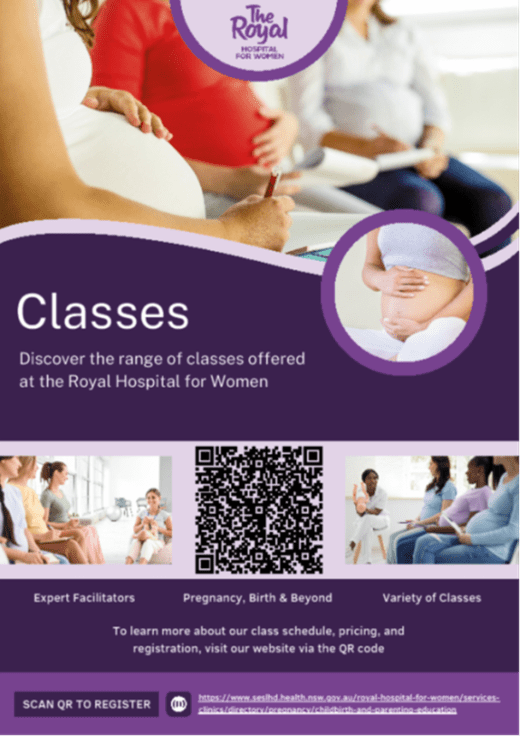
The RHW antenatal education classes have been updated to align with current evidence and NSW Health policies and frameworks including First 2000 Days, Safe Start, Women-Centred Care, and the Safer Baby Bundle. The contemporary approach to education and facilitation is designed to keep couples interested and engaged with the content.
Birth and Transitions to Parenthood is a 12-hour antenatal education course designed for expectant parents to gain the knowledge, skills, and confidence to navigate pregnancy, labour, birth, and the early weeks of parenthood. Delivered by registered midwives trained in group facilitation, the course uses adult learning principles to ensure content is relevant, practical, and personalised to each family’s needs.
Participants explore topics such as birth planning, labour stages, pain management options (medical and non-medical), newborn care, postpartum recovery, breastfeeding, partner support, and early parenting. The course fosters a supportive, inclusive environment where couples can share experiences, reflect, and prepare together for their unique journey into parenthood.
Immunisation Weekly Update: FluMist expires soon Providers are reminded to check FluMist expiry dates as some stock will be expiring in two weeks on 5 June 2026, with the remainder expiring on 10 July 2025. The NSW FluMist program will continue to run until the vaccines expire, and providers are encouraged…
Media release: Bloodborne virus risk for patients of dental practice in Strathfield Media release from NSW Health, 13 May 2026 Patients of a retired dental practitioner in Strathfield who practised for more than 25 years are being advised to seek testing for bloodborne viruses.NSW Health advises all patients who were…
Immunisation Weekly Update: FluMist program – Ends June 2026 Flu Checker Tool Yellow fever guidelines updated Measles alert for Sutherland Shire Education FluMist program – Ends June 2026 In NSW, FluMist nasal spray influenza vaccine is free for children aged 2, 3 or 4 years old as part of the NSW Nasal Spray Influenza Vaccination Program. The FluMist nasal spray will only be available until June 2026. Clinicians should strongly encourage FluMist vaccination for all eligible children. Influenza can cause serious…
Immunisation Weekly Update: Eight vaccines linked to a lower risk of dementia Introduction of AIR due and overdue rules for influenza Poliovirus found in wastewater in Western Australia Vaccination is the best preparation: childhood and winter resources Education Eight vaccines linked to a lower risk of dementia Gavi has reported that a number of large observational…
CESPHN Aged Care Onsite Pharmacist Transition Grants Program Central and Eastern Sydney Primary Healthcare Network (CESPHN) is seeking expressions of interest (EOI) from Residential Aged Care Homes (RACHs) interested in participating in an Aged Care Onsite Pharmacist (ACOP) Transition Grants Program. The program provides structured funding to support RACHs to embed…
Immunisation Weekly Update: Re-emergence of diphtheria – ensure your patients are vaccinated World Immunisation Week Co-administration of influenza and pertussis vaccination safe during pregnancy Education Re-emergence of diphtheria – ensure your patients are vaccinated The Australian Society for Infectious Diseases (ASID) have issued a statement warning about the re-emergence of respiratory diphtheria, and…